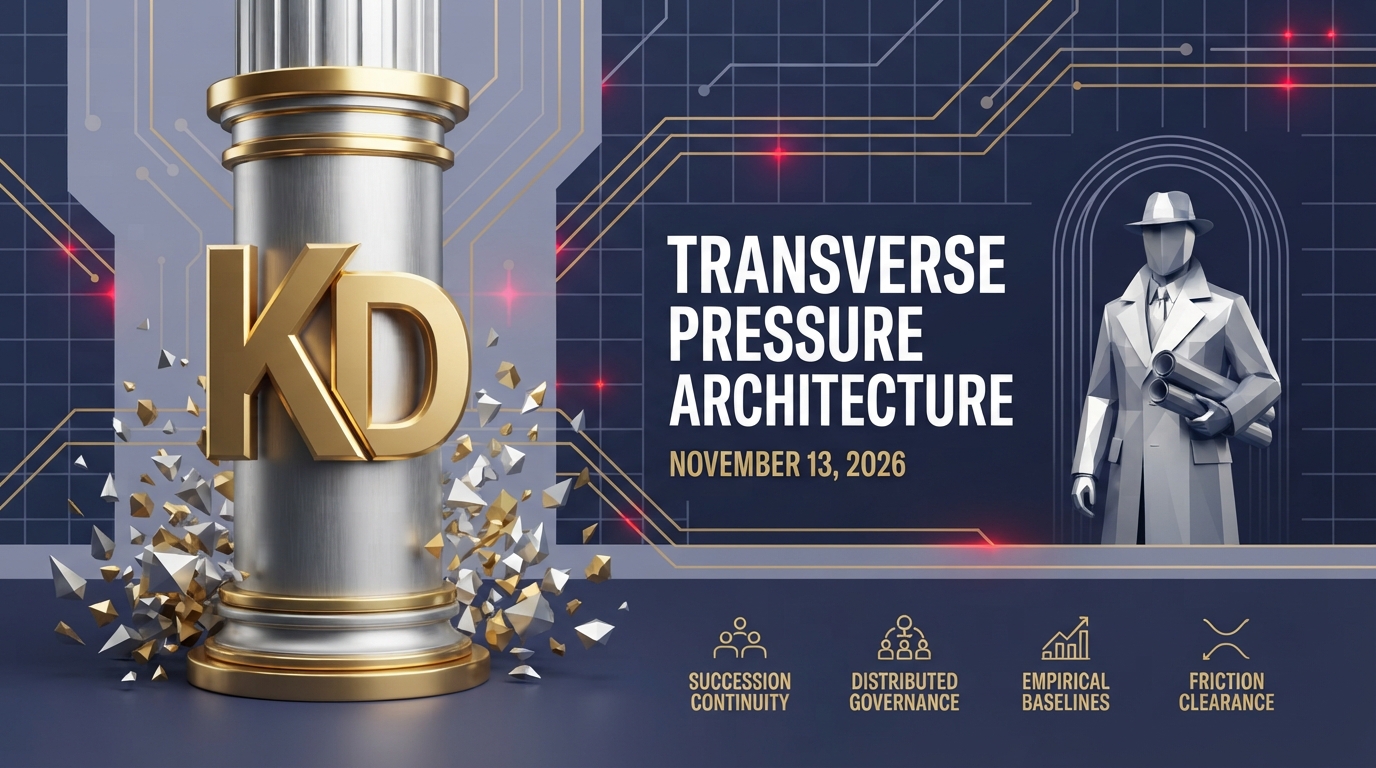
On This Day In History
Section Summary
- On November 13, 1927, the Holland Tunnel officially opened to vehicular traffic beneath the Hudson River, connecting Manhattan and Jersey City.
- Chief Engineer Clifford Milburn Holland and his successor Ole Singstad solved the lethal threat of trapped carbon monoxide through an unprecedented transverse airflow design.
- Eighty-four massive electric fans housed in four riverbank towers replaced the entire tunnel’s atmosphere every ninety seconds, establishing the global standard for subterranean infrastructure.
At one minute past midnight on November 13, 1927, the first automobiles rolled beneath the Hudson River through the newly completed Holland Tunnel. Before this breakthrough, crossing between New Jersey and New York City required enduring hours of congested ferry bottlenecks. Critics and rival engineers declared an underwater car passage impossible, warning that invisible engine exhaust would suffocate drivers within minutes. Chief Engineer Clifford Milburn Holland refused to accept those limits, leading exhaustive medical and chemical tests in a Pennsylvania coal mine to prove humans could safely cross if poisonous gas remained below four parts per ten thousand. Tragically, the relentless physical toll claimed Holland’s life at age forty-one just days before the twin iron tubes met beneath the riverbed. His successor, Milton Freeman, died five months later, leaving third Chief Engineer Ole Singstad to finalize the radical transverse airflow design. Rather than blowing air lengthwise like a wind tunnel, Singstad engineered fresh air ducts beneath the roadway and exhaust vents overhead. Four monumental riverbank towers housing eighty-four giant fans completely refreshed the underground atmosphere every ninety seconds, transforming a deadly engineering hazard into an enduring triumph of human perseverance.
Listen to Today’s Executive Intelligence Briefing
Short on reading time? Stream today’s 90-second narrated executive synthesis below or follow our official Spotify feed for daily morning audio drops.
The Modern Framework
Section Summary
- Modern institutions face hidden operational toxicity whenever rapid growth outpaces internal clearing mechanisms.
- The Transverse Pressure Architecture framework equips government, military, and enterprise leaders to vent friction before system collapse.
Building high-speed operational corridors without dedicated clearing mechanisms guarantees organizational suffocation. Modern government agencies, military commands, and global enterprises frequently accelerate production while allowing bureaucratic exhaust, unresolved disputes, and stalled approvals to accumulate inside closed workflows. Applying the Transverse Pressure Architecture framework solves this lethal bottleneck by installing vertical intake and exhaust pathways at every layer of execution rather than waiting for problems to clear at the end of the quarter. When institutions actively pump fresh clarity from the floor upward while extracting stale blockers overhead, massive operational volume moves safely at full velocity.
Get Today’s 90-Second Spoken Briefing & Morning Mobile Alerts
Prefer listening on your morning commute or receiving instant tactical flashes throughout the day? Join our private, end-to-end encrypted WhatsApp Channel for 6:00 a.m. briefing alerts, spoken-word audio drops, and deeper executive discussions—with zero public member visibility.
The Leadership Pillar: Engineering Institutional Habits
Section Summary
- Executives destroy organizational stamina when they hoard critical decisions instead of building self-sustaining leadership benches.
- Succession continuity relies on documented operational standards rather than heroic individual overexertion.
Relying on personal endurance to carry a massive enterprise across the finish line is a guaranteed recipe for executive burnout and sudden leadership vacuum. When senior directors treat every operational crisis as a personal test of willpower, they inadvertently starve their rising managers of the authority needed to steer the ship. True institutional stewardship requires embedding clear decision rules and shared checklists into daily team routines long before an unexpected departure tests the chain of command. Organizations survive the sudden loss of a visionary founder only when their operational blueprint is transparent enough for the next leader to step into the seat without losing momentum.
The Strategy Pillar: Designing the Governance Framework
Section Summary
- Traditional end-to-end linear oversight fails when transaction volume expands across multiple jurisdictions.
- Multi-node governance checkpoints neutralize regulatory gridlock and cross-border compliance hazards before launch.
Map distinct jurisdictional checkpoints across every regional division long before scaling operations into new territories. Traditional corporate governance relies on pushing massive initiatives down a single, narrow approval corridor, which inevitably creates paralyzing logjams when local regulations collide. Smart strategists replace single-file oversight with distributed regional towers that monitor compliance, treasury exposure, and supply chain friction independently at each local node. By decentralizing oversight while maintaining unified safety thresholds, leadership teams protect enterprise equity against sudden geopolitical shocks and legal liabilities.
The Performance Pillar: Command the Precision Baseline
Section Summary
- Guessing at operational capacity invites catastrophic failure when real-world stress hits peak volume.
- Empirical stress testing establishes hard mathematical thresholds that keep frontline teams performing safely under maximum load.
When operational volumes accelerate rapidly, unverified assumptions about team capacity collapse under the weight of real-world demand. High-performing divisions reject optimistic projections and instead run controlled pre-launch stress simulations to pinpoint exact breaking points before committing live capital. Establishing hard numerical baselines—such as strict turnaround timers, error ceilings, and resource burn limits—gives frontline professionals unambiguous guardrails during peak surges. Teams execute with calm speed when every operator knows the exact mathematical boundary separating safe throughput from systemic overload.
The Culture & Impact Pillar: Eliminating Operational Friction
Section Summary
- Departmental walls trap unspoken frustrations and turn minor workflow misunderstandings into toxic cultural resentment.
- Open floor-to-ceiling communication channels clear out daily workplace tension before morale erodes.
Clearing out stale workplace resentment requires installing transparent feedback channels directly inside daily team workflows. In legacy corporate cultures, frontline workers swallow procedural frustrations until silent disengagement poisons entire departments. High-trust organizations treat candid operational feedback as vital oxygen, creating rapid floor-to-ceiling escalation paths where employees flag broken tools or conflicting priorities without fear of blame. When leadership visibly removes stalled policies every single week, workforce morale stays energized and cross-functional collaboration thrives naturally.
The Innovation & Tech Pillar: Architect Before You Amplify
Section Summary
- Automating a broken, unventilated workflow merely accelerates organizational chaos and technical debt.
- Technologists must design modular data intake and error-purging pipelines before deploying artificial intelligence at scale.
Deploying artificial intelligence across legacy software without first building automated error-purging pipelines simply magnifies bad data at machine speed. Software architects and technical leads often rush to scale compute power while ignoring the hidden accumulation of corrupted inputs, latency bottlenecks, and unmonitored model drift. Resilient technology stacks separate data ingestion from diagnostic telemetry, running continuous background health sweeps that isolate and flush bad packets every few seconds. By engineering self-cleaning infrastructure first, developers ensure that enterprise automation scales safely without suffocating downstream users.
The Tactical Pivot (The Counterfactual Audit)
Section Summary
- Early twentieth-century bridge advocates and conventional tunnel planners assumed lengthwise airflow could clear a mile-long roadway.
- Had planners relied on longitudinal fans, hurricane-force winds would have made driving impossible while failing to purge deadly fumes.
Conventional engineering wisdom in the 1920s insisted that pushing air straight from one end of a tunnel to the other was the only logical way to ventilate an underground passage. Had project leaders followed that status quo, moving air across more than eight thousand feet would have required hurricane-force winds inside the roadway while still leaving deadly pockets of concentrated fumes in the center. By pivoting to cross-sectional airflow chambers beneath the floor and above the ceiling, the project team neutralized lethal gas without creating dangerous wind resistance for drivers. Modern executives face the exact same choice when scaling: either force more pressure down a single linear hierarchy or redesign the underlying structure to breathe at every point along the line.
Context and Analysis for High Potentials
Section Summary
- Rising leaders prove their readiness for senior promotion by mastering unglamorous, behind-the-scenes reliability metrics.
- High potentials distinguish themselves by building repeatable systems that outlast their personal presence on a project.
Demonstrating readiness for senior executive promotion requires proving you can build repeatable systems that run smoothly even when you step away from the desk. Rising staff often mistake visible busyness and late-night heroics for leadership potential, yet senior boards promote builders who eliminate recurring emergencies through disciplined preparation. High potentials should audit their current workflows to identify hidden single points of failure, documenting clear handoff protocols and measurable quality checks for every junior teammate. When your unit delivers spotless execution without your constant manual intervention, you signal unmistakable maturity for enterprise-wide command.
- Internal Leadership Archetype Sync: Audit your natural Myers-Briggs decision-making style against today’s mandate for inclusive institutional redesign to spot where you cling to legacy habits.
- –> Coming Soon: Cross-reference your psychological baseline against today’s operational stress markers to unlock your custom executive development pathway.
Context and Analysis for C-Suite and Government Leaders
Section Summary
- Public infrastructure and enterprise capital require long-horizon stewardship that outlives short-term political or quarterly cycles.
- Cross-jurisdictional cooperation turns divided regulatory authority into unified economic mobility
Aligning multi-state agencies, municipal boards, and private capital around generational infrastructure demands governance structures built to survive leadership transitions. Senior executives and public officials frequently stall transformational projects by fighting over short-term credit or turf boundaries across neighboring jurisdictions. Lasting institutional legacy belongs to leaders who codify joint operating charters, shared funding pools, and independent safety commissions that remain intact regardless of election cycles or boardroom reshuffles. When C-suite officers and government directors prioritize durable public utility over immediate political applause, they unlock decades of compounding economic velocity.
The Enterprise Audit Matrix (The 60-Second Blueprint)
Section Summary
- Rapid self-audits expose structural bottlenecks before minor friction escalates into systemic failure.
- Leaders must pair every operational red flag with an immediate, measurable corrective action.
Scan the diagnostic matrix below to identify hidden pressure buildup across your leadership bench, governance structure, and execution baselines before launching next week’s priorities.
| Organizational Friction Point | Severe Vulnerability Indicator (Red Flag) | Optimization Checklist Action (Fix) |
| Executive Succession Bench | Single-leader dependency bottleneck | Document critical handoff protocols today |
| Multi-Region Governance | Centralized approval gridlock | Deploy autonomous local compliance checkpoints |
| Workflow Capacity Limits | Unverified peak-load assumptions | Run empirical stress tests before scaling |
Words of Encouragement
Section Summary
- Enduring breakthroughs belong to builders who solve invisible structural hazards before inviting the public inside.
- Disciplined preparation turns impossible engineering challenges into everyday highways of progress.
Every enduring triumph in business and public service rests upon unseen architecture engineered long before the ribbon is cut. Whenever your team confronts a daunting obstacle that skeptics call impossible, remember that breakthroughs rarely come from louder promises or brute force alone. True resilience emerges when disciplined leaders measure the hidden risks, reinforce the supporting walls, and build reliable clearing systems that keep people safe under pressure. Step into your upcoming week with quiet confidence, knowing that the careful guardrails and honest standards you install today will carry thousands safely forward long after the work is done.
The Motivation Matrix
Section Summary
- Three core maxims anchor today’s briefing across execution stability, system architecture, and institutional habits.
- Apply these principles to align frontline discipline with long-term enterprise durability.
Distill today’s historical lessons into three immediate operational mandates for your leadership team.
Invisible Guardrails Enable Visible Speed: Build rigorous safety thresholds and clearing systems underneath your operations so frontline teams can move at maximum velocity without fear of collapse.
Architect Ventilation Before Opening the Gates: Design modular intake and feedback channels across every layer of your organization before scaling volume or launching public initiatives.
Institutionalize the Blueprint Beyond the Builder: Codify your standards, measurements, and succession protocols into shared team habits so your mission endures across generations.
The Automated Catalog Multiplier
To unlock the full strategic management breakdown of today’s historical analysis, secure your copy of the King Davis Master Success Guide Matrix directly through our authorized global publishing node: The Strategic Success Guides Catalog
- Span of Control Framework | The Proverb Diagnostic: Trying to push an entire enterprise through a single executive bottleneck without distributed ________ guarantees systemic gridlock under peak demand.
- Standard Case Study | The Parable Diagnostic: Establishing strict mathematical safety ________ before launching high-volume operations transforms a lethal hazard into a repeatable triumph. The defining of the _ _ _ _ _ _ _ _ _ standard of which we are judged should be a subjectively defined objective. It must be related to where one has _ _ _ _ and is _ _ _ _ _; the history of occurrences; the measures of human _ _ _ _ _ _ _ _ _ _ _ _. There can be little confidence held within a uniform _ _ _ _ _ _ _ _ which does not consider the frailty of human _ _ _ _ and _ _ _ _ _ _ _ _ _ _. Character standards should celebrate the _ _ _ _ _ and support the _ _ _ _ _ _. For the gradient can be, both, diverse and _ _ _ _ _ _ _ _.
- Stewardship Parameter | The Strategic Principle Diagnostic: When a visionary founder exhausts their personal health without codifying succession ________, only a documented architectural blueprint saves the enterprise from collapse.
The Premium Executive Intelligence Briefing
Executive Intelligence Briefing | Audience Privacy Guarantee
#ExecutiveIntelligence #OrganizationalArchitecture #CorporateGovernance #OperationalResilience #LeadershipStrategy #SystemDesign #KingDavisBriefs #OnThisDayInHistory